Connectors and JEV: Implications for Building in Agentic Commerce
What connectors and JEV mean for your shop, what happened in our shopping tests, and practical first steps for merchants and shopping-app builders.

SPECIAL EDITION · HOW AGENTS SHOP
This week is a special edition on two major developments in agentic commerce: connectors and JEV. But first, the week’s trending news.
Trending news of the week
1. Muse reaches 2.8 million downloads
Apptopia estimates Muse reached 2.8 million installs in its first 12 days, TechCrunch reports. For merchants, that is a reason to start exploring the customer experience now. The audience is arriving quickly; the useful question is how your business can serve it.
2. A diner gets banned for sending an AI agent
Resy deactivated a customer’s account after an AI assistant went looking for a table on their behalf, Restaurant Business reports. The agent was making roughly 200 requests an hour, around the clock, and Resy’s terms prohibit unsanctioned bots. This looks like the first widely reported case of a reservation platform penalizing a customer for using an agent. Every business will face the same decision: welcome agent traffic, restrict it, or block it — and enforce that without punishing the customer who sent it.
3. Mastercard and Visa race to set the rules for agent payments
Mastercard released an option on September 18 that lets a cardholder hand an AI agent a virtual card with spending limits, merchant restrictions and approval rules, so the agent can buy without checking in each time, Fortune reports. Visa’s own version is still being deployed. Industry executives describe it as a land grab for the infrastructure standards. If you are thinking about connectors and payments, the rules for delegated payment are being written above you right now.
Special edition: connectors and JEV
Imagine a shopper asking an agent: “Find a jacket in this color and size, then put one in my cart.” The agent can use your website the way a customer does, clicking through pages, or ask your shop’s system directly through a connector.
After months of testing how frontier models shop, my view is straightforward: cheaper shopping agents are emerging and will make shopping through the web much more common. Your shop can serve them through a direct connection or through the website you already have. Two developments matter here.
- Connectors give agents a direct way to use your shop’s services.
- JEV helps builders put fast, lower-cost decisions inside a shopping agent.
We ran quick experiments to understand what these developments mean in practice. This is a guide to what we learned and what I would try next, rather than a full model evaluation. Start with connectors if you run a shop; the JEV section explains what is changing for the apps that could bring shoppers to you.
Connectors: give agents a direct way to shop with you
A connector is a pre-built connection inside an app such as ChatGPT, Claude or Muse that lets an agent use specific services without browsing their websites. Think of it as a short menu of things the agent can ask your shop to do: find a product, check stock or add an item to a cart.
For example, a shopper asks: “Does this jacket come in blue, size medium?” A connector could ask your shop for that exact combination and return the answer. If the shopper wanted it, the agent could use an add-to-cart service to prepare the purchase.
Same shopper, same jacket — two ways to reach your shop
Browser: open your website → find the jacket → select blue and medium → add to cart.
Connector: ask your system for the blue, medium jacket → request an add to cart.
The opportunity is to serve customers inside an AI conversation. Your products, stock and prices become information an agent can use directly. The merchant’s job is to make those answers accurate and the available actions useful.
Muse, Meta’s personal AI agent, offers a concrete starting point. Its connector platform accepts services for review and lists approved connections in its directory.
What Muse got right about availability
We asked Muse about one Chicago restaurant at 7 p.m. on a fixed date, for two people and for eight. It correctly reported the important distinction in all six attempts: neither group could get 7 p.m., but eight people could get a table at 6:30. There was no alternative for two within our requested window.
That is the kind of answer a customer needs. Finding the restaurant was only the first step; Muse also had to preserve the date, party size and acceptable times. For your shop, the equivalent is knowing that a jacket is available in blue and medium, even if another size is sold out.
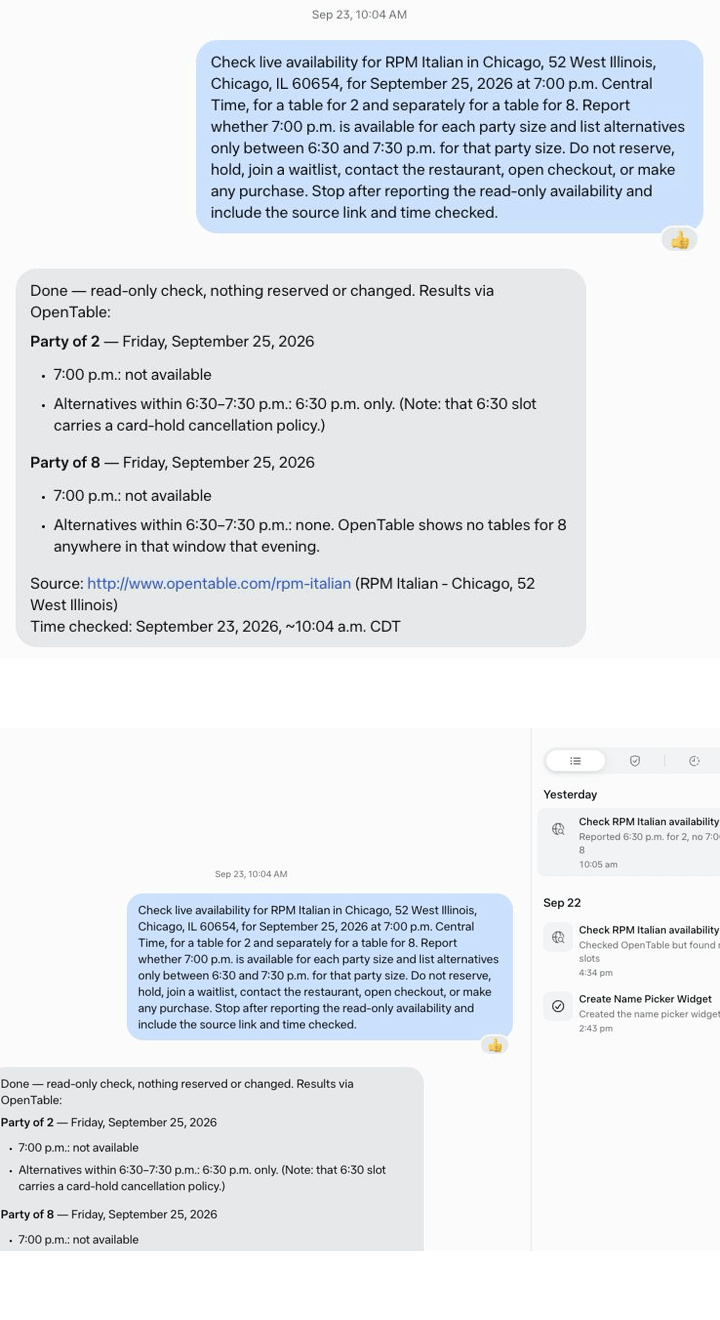
Animated walkthrough using captured screens from a September 23 availability check; no reservation was made. Availability differs from our September 19 experiment.
Where I would start as a merchant
I would evaluate a connector for one useful shopping task, with help from your ecommerce provider or developer.
- Start with product lookup and adding the chosen item to a cart. Make the required size, color and quantity explicit.
- Check the connection against your live stock and prices. Try a sold-out option as well as an available one, then inspect the resulting cart.
- Choose one platform first. Use Muse’s submission page to describe your service and enter its review process, which includes end-to-end testing before directory approval.
- Add payments once lookup and cart creation work well. Muse supports payments through Stripe’s Link; ask your provider how your checkout, customer approval and order confirmation fit that flow.
A connector gives your shop a direct route into the conversation. Browser-based agents offer another route, including for shops that never build a connector. That is where the economics of running the agent become particularly interesting.
JEV: make the agent’s smaller decisions faster and cheaper
JEV is an AI model from TypeSafe, a company building models for software decisions. Instead of writing an answer word by word, JEV chooses from options supplied by the software. TypeSafe introduced it on September 15.
For the jacket request, one model can plan the shopping trip while JEV helps pick the matching product or the next action on the page. Browser software carries out the action, and a separate check confirms that the cart is right. This division of work is what we mean by a hybrid.
To understand our test, it helps to know the two general-purpose models we compared. Sonnet is the mid-tier model in Anthropic’s Claude family, available across Claude’s apps and coding tools; we used it as our frontier-model benchmark. Flash-Lite is a much cheaper model in Google’s Gemini family, built for fast, everyday work such as processing documents and handling smaller tasks inside an app.
Our hybrid: plan → pick → act → verify
Plan — Flash-Lite works out the next steps and helps recover from problems.
Pick — JEV chooses among the available actions.
Act — our browser automation clicks and enters the selections.
Verify — a separate cart check confirms the item, variant and quantity.
For a merchant, this matters because agents can shop through the website you already have. For the company running the agent, cheaper decisions make frequent shopping assistance more practical. A connector and a hybrid can also work together: the connector supplies a service the agent can call, while the decision system chooses what to do next.
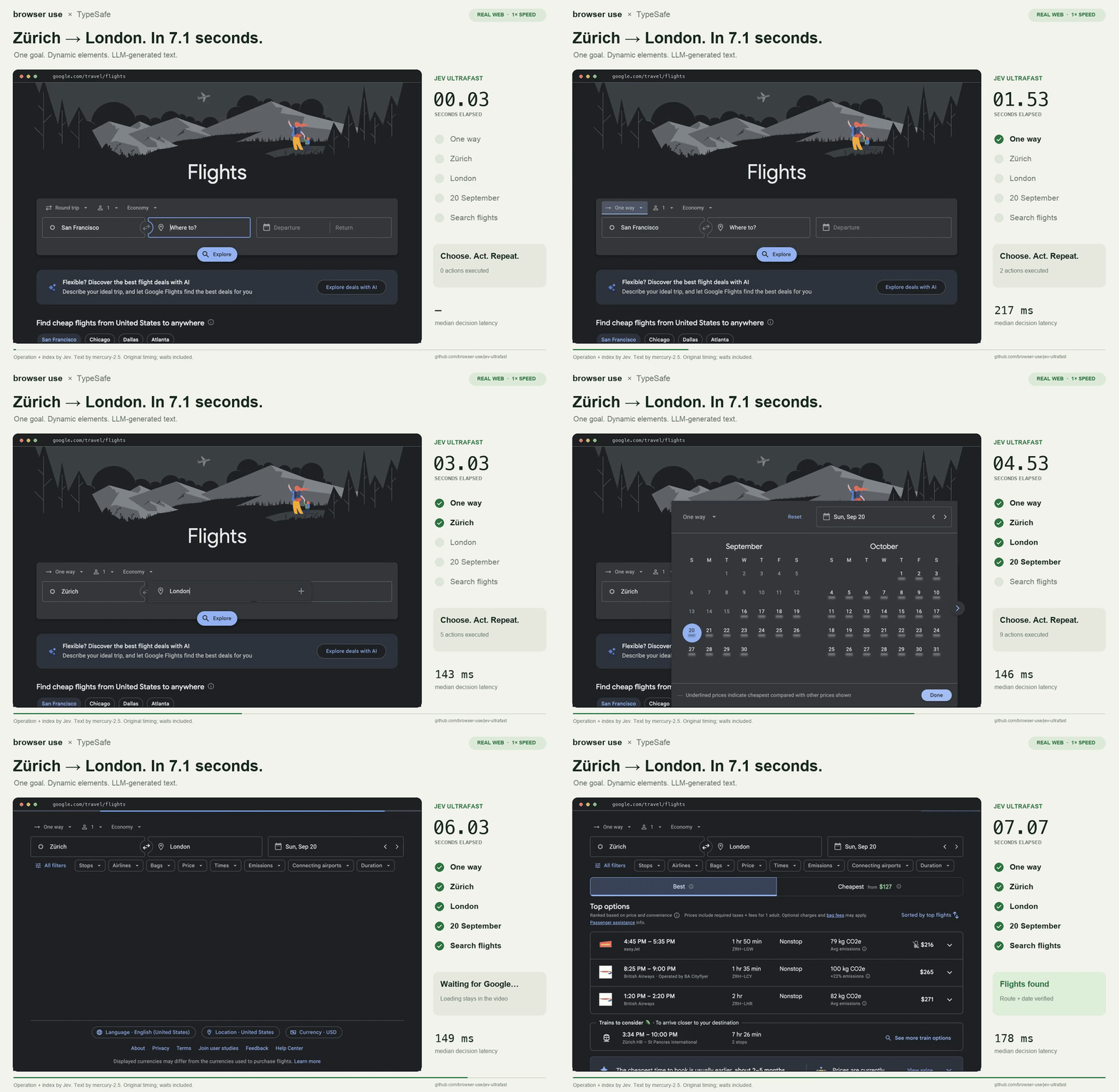
Browser Use + JEV flight-search demonstration, shown at normal speed. Original video shared by @andytng28. Separate from our cart tests.
What happened when we tested JEV
The most interesting result came from the cheap model. Flash-Lite alone got one cart right in six attempts. Our JEV and Flash-Lite hybrid got five right, coming close to Sonnet’s six on the same tasks.
The hybrid used about a quarter of the estimated model cost per correct cart, with roughly 30% shorter attempts than our Sonnet baseline. That is a compelling starting point for a team trying to make a shopping assistant economical to run.
We tested two requests: adding two of an exact cookware item, and adding one clothing item in a specified size and color. Each setup made six attempts, and we checked the actual cart. Here is the comparison:
| Setup | Correct carts | Median attempt | Cost per correct cart, relative to Sonnet |
|---|---|---|---|
| Sonnet | 6 of 6 | 92 sec | 1× |
| Sonnet + JEV hybrid | 3 of 6 | 194 sec | 2.5× |
| Flash-Lite + JEV hybrid | 5 of 6 | 65 sec | 0.25× |
| Flash-Lite | 1 of 6 | 59 sec | 1.1× |
The cheaper model on its own was quick, but failed too often to deliver the same value. Pairing JEV with Sonnet also performed worse in this comparison. The promising result came from how the cheaper model, JEV and browser automation worked together.
Where I would start as an app builder
If I were building a personal assistant that shops across many websites, I would investigate this hybrid first. Maintaining separate connections to dozens of shops could become a substantial job for a small team. Browser automation gives the app broad reach; the hybrid helps make that reach more economical. Use reliable connectors where they already cover a task well.
Our setup used Flash-Lite for planning and recovery, JEV for action selection, and custom browser automation to operate the website. Browser Use is one tool you could evaluate for that last layer.
Start with one customer request and check three things: did the cart match it, how long did the attempt take, and what did it cost to reach the right result? Include the cost of recovering from mistakes. When a cart update is uncertain, read it again before retrying an add.
Build agent identification and permission handling into that first version. Identify the agent where the site supports it, use the required sign-in or authorization, and keep purchases within the customer’s permission.
What store owners should check
- Explore connectors early. Muse has opened its directory to developers. Share the developer portal with your team and identify one useful service your shop could offer, starting with product lookup or cart creation.
- Check what your reporting misses. GEO tools often measure mentions; website analytics measure visits. A connector can handle a reservation without a visit to your site, and a mention alone will not tell you how it happened. Ask your GEO and booking providers whether they can attribute connector-driven activity to the originating app.
- Prepare for more agent traffic. As JEV and cheaper hybrids spread, expect more consumer apps to shop through the web. Review settings so legitimate shopping agents can access your store, and ask your team to separate detected agents from humans in Cloudflare or Amazon Web Services reporting.
About these quick experiments
The main JEV comparison comprised 24 attempts across two previously qualified tasks on September 20, 2026. Exact median attempt times were 91.6, 194.2, 65.1 and 59.0 seconds in table order. Estimated provider cost per correct cart was $0.561, $1.379, $0.141 and $0.629; all attempts, including failures, contribute to those costs. Times include unsuccessful attempts and exclude cleanup. Costs include rate-card estimates and allowances for unresolved charges, but exclude browser infrastructure, development and review subscriptions. Five of six versus six of six describes these outcomes, not equivalent reliability.
These were adapted browser setups with different model and serving configurations. A cart-action reconciliation defect contributed to the Sonnet hybrid’s failures. Only 11 of the 24 sessions had verified empty-cart cleanup. A later 16-attempt comparison recorded four correct carts out of four for Sonnet and each hybrid, and two for Flash-Lite alone; the Sonnet hybrid remained slower and software defects delayed some attempts. Subsequent repair checks were mixed, and one of four final carts in a September 21 timing check was visually unsettled. We keep these changed setups separate. Our browser implementation was custom; these results do not evaluate the Browser Use product or isolate JEV’s individual contribution.
The Muse test repeated one restaurant request in one account on September 19. Three prompts requested the connector and three requested the browser. Browser use was visible, but connector use could not be independently confirmed, so this was not a verified connector-versus-browser speed or accuracy comparison. Some answers added incorrect or unverified details beyond the core availability result. Shared memory or caching was not ruled out. No reservation or purchase was made. The connector recommendation is an architectural starting point, not a measured advantage from this test. We have not tested a Muse–JEV integration or measured a rise in agent traffic.
If you are trying either route, I would be interested to compare notes. Subscribe free to How Agents Shop to follow our next tests.