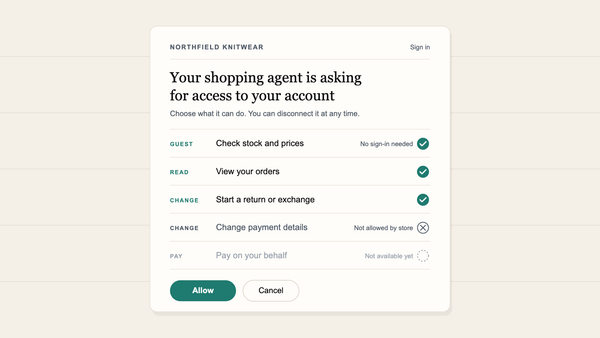
Shoppers say they’d let an agent fill the cart. We sent four to try.
A third of shoppers say they’d let an AI agent fill their basket. We sent four leading AI agents to eleven big retailers to try. One got an item into the cart.
STUDY · HOW AGENTS SHOP
This week is a study issue: what happens when an AI agent tries to put something in your cart. But first, the news behind it.
In the news
1. “Make your site readable to agents” goes viral
On October 19, Rob Hoffman posted a step-by-step thread on how he got his brand to dominate AEO, with eleven fixes to get there. It passed 400,000 views in two days. His first fix isn’t about products at all: name every icon button, label every form field, and use real buttons instead of styled boxes, because the page’s accessibility tree “is literally how Muse reads your website.”
Most advice on AI visibility is about getting recommended. His point is that an agent also has to be able to use your page. Our test this week looked at the next step: getting into the cart.
Read more: 11 optimizations for Meta Muse (Rob Hoffman on X) →
2. Agents send good buyers. They don’t close.
Adobe’s July retail data has shoppers who click through from an AI tool converting 60% better than other visitors, the eleventh month in a row they have led. The opposite happened when the agent did the buying: Walmart said purchases finished inside ChatGPT converted at a third of the rate of shoppers who clicked through to Walmart.com, and OpenAI has since moved away from in-chat checkout towards checkout run by the merchant.
Read more: AI-referral traffic spending, converting more than counterparts (Digital Commerce 360) →
Read more: Walmart says ChatGPT checkout converted 3x worse than its own website (MarTech) →
3. Shoppers want to approve the purchase
Ping Identity’s new survey of 11,000 people in 12 countries found just 3% comfortable with an agent completing routine purchases without a final approval. 42% would cap an agent’s spending at $100, and 47% said having to keep checking the agent’s work worries them more than the agent making a mistake.
Read more: AI trust changes when assistance turns to action (iTWire, on Ping Identity’s survey) →
A third of shoppers would let an agent fill the cart. Can it?
Surveys ask shoppers how far they would let an AI agent go. The answer drops at each step:
| Step | Shoppers who say yes | Source (sponsor) |
|---|---|---|
| Recommend a product | 59% comfortable | NMI (payments), August 2026 |
| Build the basket while I pay | 32% | Accenture Consumer Pulse, January 2026 |
| Pay with no approval | About 10% | NMI; Accenture 9% |
The middle row is the one that matters for your store. A third of shoppers say they would let an agent pick the items and fill the basket, as long as they press pay. But every number on that row is what people say. Nobody publishes how often agents actually manage to add something to a cart on a real store.
So we tried. On October 15 we sent four leading AI agents, from OpenAI, Anthropic, Google and xAI, to eleven large US retailers in fashion, general merchandise and grocery. Each had one plain task: find a named product, put it in the cart, and stop before paying.
My short answer: agents find your store, and often your product. Then they stop short of the cart.
22 attempts, one task: put this product in the cart
| STEP 1 | Reached the store: 20 of 22Two agents never got past the home page. |
| STEP 2 | Found the product: 12 of 22Eight stopped before they had search results to work with. |
| STEP 3 | Put it in the cart: 1 of 22The one that did went on to the payment page and stopped there, as told. |
Want to see how agents shop your own site?
Observatory sends AI shopping agents to your domain every day and reports what they find. $79/month.
They didn’t break. They left the last step to the shopper.
We expected crashes and blocked pages. What we mostly saw was agents deciding they were done. In 15 of the 21 attempts that didn’t reach the cart, the agent ended the task itself and gave an answer instead of carrying on: it reported what it had found and left the rest to the shopper.
In five more attempts, the agent reached the product step but the product it had been asked for wasn’t on the page it landed on: out of stock in that size, regional, or behind a store or ZIP selector. One was cut off before it finished.
That is the same pattern Walmart and Adobe describe at scale: agents do the research and leave the buying to people. Shoppers seem to want it that way. In Ping’s survey, almost nobody wants an agent to finish a purchase unattended, and 47% said having to keep checking the agent’s work worries them more than the agent making a mistake. An agent that stops at the cart and lets the shopper finish may be doing exactly what shoppers want. The job for your store is to make that last step easy.
What this means for your store
Agents now send shoppers to your checkout. Most agents that reach your store today will look, compare and send the shopper on to you. That isn’t bad news: those shoppers convert well. But the page they land on has to finish the job the agent started.
The cart is where agents need the most help. Recommendation is moving fast. Getting from the product page into the cart is the step where agents stop, and it is the step you control.
What store owners should check
- Try it yourself. Ask an agent with a browser, such as ChatGPT agent, Comet or Claude in Chrome, to add one of your products in a specific size to the cart. Watch where it hesitates or stops.
- Make the cart controls real controls. “Add to cart”, size and colour should be real buttons and fields with names. Make sure the chosen size shows on the page as text, not only as a highlighted swatch.
- Make the last step one tap. When an agent sends a shopper to you, they should land on the right product with the size already chosen, or on a cart that is already filled. If your product links can’t carry the size, the shopper starts again.
About this study
This is a small study: one weekly cycle of our commerce test, run on October 15, 2026. Four AI models (OpenAI GPT-5.5, Anthropic Claude Sonnet 4.6, Google Gemini 3.5 Flash and xAI Grok 4.6) each had the same task at eleven large US retailers, run through our own browser agent rather than each company’s consumer app. Agents were told to stop before payment, and none went past it.
Of the 44 attempts, 22 ended for reasons on our side: our step limit, a page control our browser tool could not operate, or a browser session that failed to start. We leave those out, so every figure above is out of the 22 attempts that ended on the agent’s own terms. One cycle is too small to compare models or retailers, and we don’t. We run the test every week and will report as it builds.
Survey figures are as published. Most of those surveys were commissioned by companies that sell into agent commerce; the sponsor is named next to each figure. They measure what people say, not what they do.
If you’re watching agents on your own product pages, I’d be interested to compare notes. Subscribe free to How Agents Shop to follow our next tests.
kya Observatory
See how agents navigate your site
Before you decide what agents should do on your site, see what they do today. Every day, our agents check whether they can get in, how far they get, and whether they come back with the right product, price and stock.
Get a weekly custom tracker for your domain. $79/month.